Some members of the Worshipful Company of Cordwainers belong to families whose names were once famous within the world of footwear. With the demise of many British companies during the 20th century, we pay tribute to some of them here.
Peal and Co., bootmakers, produced bespoke footwear from 1791 until 1965. The founder, Samuel Peal (1754-1819), was a shoemaker from Wirksworth, Derbyshire and he is the ancestor of the dozen or so Peals who are members of the Cordwainers Company today.
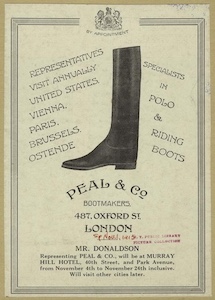
In 1791 Samuel took out a patent for rendering clothing materials waterproof by finely brushing them with a coat of caoutchouc, Indian rubber solution. He moved to Stepney Green in London and set up Peal & Co, making boots using his own waterproof ‘patent’ leather.
The process quickly proved its worth: Peal’s boots and shoes becoming renowned for their comfort and durability. The success of their products allowed the firm to relocate to the more prestigious West End, where their growing reputation won ‘patronisation by the Royal Family’ and subsequent royal warrants.
World-class reputation
During its 174-year history, control of Peal & Co. passed through six generations of the Peal family. The second incumbent, Nathaniel Peal (1793-1862) was apprenticed in April 1808 and went on to exhibit his ‘Half-Leg Hunting Boots and Whole-Leg Hunting & Fishing Boots of Waterproof Leather’ at the Great Exhibition of 1851. A century later, Peal & Co. exhibited hunting boots with trees at the Festival of Britain in 1951.
After the war, Peal & Co. exhibited at the best equestrian events in the UK, such as the Badminton Horse Trials, where they gave a prize for showjumping. This helped the company maintain a reputation that was second to none.
This reputation was also earned by the salesmen who, from the 1880s onwards, travelled extensively throughout the world. They carried cases of miniature shoes and boots as samples (some of which are on display now in the Cordwainers offices) along with full-size examples of Peal & Co. footwear and other leather goods.
Last orders
By the 1960s around two-thirds of the footwear produced went to export. In addition to taking measurements, the salesmen made outline drawings of every customer’s feet. These were kept in a series of ‘Feet Books’ that now form the bulk of the massive archive collection held at the London Archives. Clients included Winston Churchill, Cary Grant, Fred Astaire, Steve McQueen, David Niven, Sir Laurence Olivier, John F. Kennedy and HM King Edward VIII.
Orders were posted or telegraphed back to the firm’s factory in Jeddo Road, Acton Vale, (opened in 1885) with delivery of the finished shoes generally taking around six weeks. In its heyday, the company employed more than 200 people and produced around 150 pairs of handmade shoes a week,
‘They had a massive Last Room storing upwards of 50,000 lasts. Peal’s lasts were a very, very good fitting last. Over the years they had worked out just about the best; they had a shape of their own, known as ‘Paris Point’, where the toe was more rounded.’ [Terry Moore, former employee of Peal & Co).
To understand their Last Room was to understand a central part of Peal’s business. Peal’s were the biggest last makers supplying virtually everybody in the West End.
Wood and leather
Peal’s had this policy: if it was in the trade, they made it. Bootjacks, pieces of furniture, anything made from wood or leather, including luggage and army uniform belting. Peals were great inventors, and they were a big family and they made sure that the workers felt included as part of the wider Peal family. In modern management terms, Peal’s was a vertically integrated company, owning each step of the process from the wood factory and their own tannery to the retail shoe-shop.
By the late 1950s Peal’s had great difficulty in replacing skilled craftsmen who had retired or left, which led to the eventual demise of the firm. Upon closure, the trading name was sold to Brooks Brothers of New York, who until recently produced a range of traditional English-style footwear marketed under the Peal banner.
Thirteen members of the Peal family have served as Master of the Cordwainers Company fourteen times since 1907 (one, Cecil Frederic, served twice in 1964 and 1970). Of those, seven were on the board of Peal & Co., two of them serving after the company closed.
Thanks to Liveryman Bernie Peal and Past Master Patrick Peal.